
How Two Private Practice Therapists Started Leaving Insurance Panels in One Week (Without Waiting Until They Felt Ready)

Since I raised my rates for new clients a few weeks ago, I've had three new clients call, book their client assessments, and start counseling with me.
Not callers asking about sliding scale. Clients who saw my rate and said yes. All three have stayed on at my full session rate.
I'm sharing that because if you're a therapist in private practice right now, you've probably been sitting with the same quiet thought so many of your colleagues are carrying… the one that's been there a while, just a little louder lately:
"What if I just… didn't do this anymore?"
I want you to know: this is possible (yes, even for you!).
For over a decade, I've been fully out-of-network. The right-fit clients are out there, looking for someone exactly like you. Your rate isn't what stops them. It wasn't what stopped my clients from working with me.
But knowing it's possible for me isn't the same as believing it's possible for you. The process can feel enormous — the rate, the letters, the panels, the ethics, all of it tangled together.
That's exactly why I created the Breaking Up With Insurance Guide. I kept having therapists ask me how I did it, so instead of continuing to answer everyone individually, I created a step-by-step program you can take at your own pace.
And recently, I invited buyers to a live Do the Work Week with me — a short challenge built around actually doing the thing, not just consuming it. Five therapists took the guide into action that week. Two completed all four challenge actions and claimed their reward: being featured in this roundup.
What Is the Breaking Up With Insurance Guide?
Breaking Up With Insurance is a guided workshop for therapists who are leaving insurance panels, or never joining them in the first place, and want to do it ethically and confidently.
It's structured as five core chapters each around 20–25 minutes that you can listen to like a private podcast, covering the money stories that keep you stuck, the Profitable Session Rate Formula (the process for finding your number — not someone else's), exactly how to resign from panels, and what to say to your clients when you do.
You can easily get through all the core chapters in one afternoon, or really take your time and let the lessons marinate.
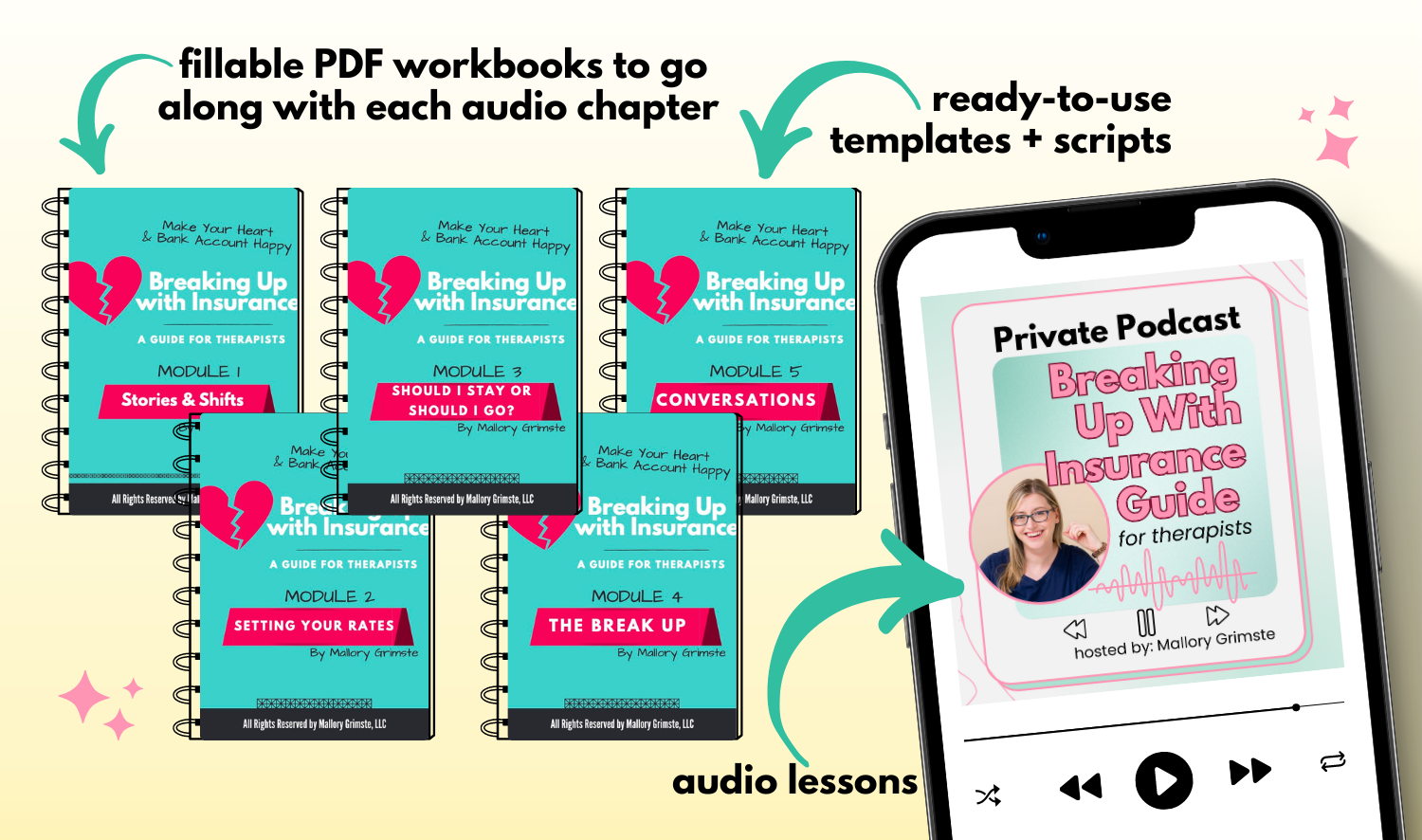
“Do the Work Week” layered a challenge on top of the guide: four concrete actions, one week. Listen to all five chapters. Run the rate formula. Post your rate somewhere it officially lives. Draft your letters.
Not someday. That week.
Along the way, I hosted two live Q&As answering the questions therapists submitted — everything from "is this even ethical?" to the exact step-by-step of resigning from a Medicaid panel. (Those replays are already added to the Workshop Hub, so everyone who grabs the guide gets them, too.)
Paige Bartels, LCSW — O.W.L. Counseling, LLC

Paige is an experienced play therapist and founder of O.W.L. Counseling, LLC, working with children ages 3+ and their families and providing parent support and coaching.
Paige believes that play is the language of children— how they talk to us and where healing is available. She has extensive training and experience working with children with Autism, ADHD, anxiety, and trauma.
Paige came into Do the Work Week the way a lot of therapists come to this decision: anxious. Not about whether she wanted off insurance panels… about what it would mean.
Specifically, she was carrying real anxiety about limiting access to care for lower-income clients.
That's not head trash to dismiss. That's a values question, and she treated it like one.
During the challenge, Paige:
Listened to all five core chapters and ran the Profitable Session Rate Formula — and was surprised to find her number was actually lower than she expected
Posted her rate on Psychology Today, her website, and her EHR
Called her insurance contract representative to find out exactly how much lead time she needs to come off the panel, and set a real timeline: fully off by end of 2026
Drafted her resignation letter (written, ready, and waiting for her chosen date), and closed to new insurance clients so her open slots stay available for private pay
Read those last two again. She didn't wait until she "felt ready" to find out what leaving actually requires. She picked up the phone, got the facts, and wrote the letter. It's sitting in her drafts folder right now — ready to send on her timeline, not some insurance panel's.
And here's what shifted underneath the logistics in her own words:
"I also am focusing on the impact to me which filters down to the work I do with clients — moving away from insurance and being underpaid leaves me feeling far more energized and available for clients."
Sit with that one for a second. An exhausted, resentful therapist isn't serving anyone… not even the clients who need her most. In her feedback, Paige said she went from feeling anxious about leaving insurance to an 8 out of 10 confidence that it's possible for her.
Her advice for therapists considering the guide?
"If you're on the fence, it's worth it. It's also worth doing the extra steps — be ready with a notebook and to pause the podcast in order to do the work."
If you're looking for a play therapist for your kiddo (ages 3+) or parent support in Branford, CT, you can learn more about Paige at O.W.L. Counseling, LLC.
Cynthia L. Mason, MS, LPC, LCPC, LMHC, NCC (she goes by Cindy)

Cindy has run her private practice in Maryland for over 15 years and recently relocated to Connecticut, where she's building her practice fresh in a brand-new state.
She works with insight-oriented clients navigating relationship and family challenges, life transitions, stress, and coping with our challenging world — and she's passionate about helping people gain clarity and contentment as they discover their best selves.
Think about what Cindy is actually doing here: rebuilding a practice from scratch, in a state where she doesn't have a referral network yet — and choosing to do it without insurance panels from day one.
Most therapists would tell you that's the situation where you "have to" take insurance. Cindy is proving otherwise.
During the challenge Cindy got a lot done (even with a late start):
Listened to all five core chapters and ran the Profitable Session Rate Formula, sitting with just how emotional rate-setting really is (her plan: start where she's comfortable and adjust as she gets established — which is exactly the kind of intentional decision the formula is for)
Posted her rate on Psychology Today and her intake form
Drafted a rate increase letter — one that will mostly affect new clients, since her Connecticut caseload is just getting started ("Really hoping for this to change soon 🤞" — her words, and honestly, same)
Went above and beyond: sent at least 3 networking and referral outreach messages to start building her Connecticut referral network
But the thing she named as the biggest impact of the week wasn't any single action:
"I was uplifted by going through this process and feeling like I was not alone in trying to figure this all out…. You gave me hope that this can be manageable and I can take some positive action that will make a difference."
That's the part nobody tells you about breaking up with insurance… the isolation is half the battle. Every therapist doing this thinks they're the only one wrestling with the emotions of it. They're not. Cindy's not. You're not.
If you're in Connecticut and looking for an insight-oriented therapist for relationship and family challenges, life transitions, or stress, you can learn more about Cindy on her Psychology Today profile.
If this is already clicking for you — you can get instant access to the Breaking Up With Insurance Guide here.
Can Therapists Really Leave Insurance Panels Without Losing Clients?
Paige called her panel, got her exact off-ramp timeline, and wrote her resignation letter — in one week. Cindy set her rate, posted it publicly, and started building a referral network in a state where she knew almost no one.
Neither of them waited until they felt ready. Neither of them had every answer first. They did the work with the emotions still present — the anxiety, the money stories, the "is this ethical?" spiral — and discovered the emotions get quieter once you're in motion.
Because here's the thing both of their stories prove: the hardest part of breaking up with insurance isn't the paperwork. It's the head trash. And head trash doesn't clear by thinking harder… it clears by doing.
The Breaking Up With Insurance Guide walks you through exactly that: the money stories, the rate math, the resignation logistics, and the client conversations — in an order that actually works.
Frequently Asked Questions About Leaving Insurance Panels as a Therapist
These aren't hypotheticals I made up for an FAQ section — every one of these came up during the two live Q&As I hosted during the challenge. (Both full Q&A replays are being added to the Workshop Hub, so they're yours when you grab the guide.)
Is it ethical to leave insurance panels? Aren't I restricting access to care?
This was the biggest one that kept coming up over and over again. You’re not alone in this dilemma.
Here's the reframe: you are not restricting access. You're operating inside a system that was built with multiple access points — in-network providers, out-of-network reimbursement, sliding scale spots, community agencies, and free findable resources (it's a huge reason my YouTube channel exists).
Meanwhile, a therapist who is underpaid, overworked, and resentful can't do her best clinical work. And a therapist who burns out and closes her practice helps no one.
Charging a rate built on ethical math is what makes long-term, high-quality care possible.
How do out-of-network benefits actually work?
Think of them like a rebate. Your client pays your full rate at the time of session — like paying sticker price at the register — and you give them a superbill (that's the rebate form). They submit it to their insurance company, and the insurance reimburses them directly, according to their plan.
You get paid your rate upfront, and your client handles the claim — and here's the thing: in my experience, insurance companies seem far more motivated to reimburse their members than paying a provider what they’re owed.
The Breaking Up With Insurance Guide walks you through this, including the client-facing resource my practice uses to help clients verify their benefits directly with their insurance company. (I also have a free guide to out-of-network insurance benefits you're welcome to share, and a blog post breaking down insurance options for therapy — in-network, out-of-network, and single case agreements.)
What's the actual step-by-step for getting off a panel — including Medicaid and Medicare?
Three steps: (1) Pull the actual contract you signed (and if you can't find it, just ask the panel for a copy — they should have it on file, and as I said in the Q&A, they're barely paying you as it is, so don't do extra free labor for them).
(2) Then call provider relations to confirm your required notice period.
(3) Don’t forget to document, document, document.
You'll honor your contract through the termination date, notify current clients, and let incoming callers know the date (and yes, there are scripts and templates included in the Breaking Up With Insurance Guide.)
*Medicaid and Medicare have some extra considerations around client eligibility for out of network or self-pay— I went through those in depth during one of the live Q&As, and that replay has been added to the Workshop Hub.
Will my clients actually stay if I go out-of-network?
When I dropped all four of the insurance I was paneled with at once, every client stayed except two — one was already approaching termination, and one made a financial decision that genuinely made sense for them (which I fully supported). Clients work with you, not your panel status. The guide covers exactly how to have those conversations.
What if I can't say my rate out loud without cringing?
Practice it — literally. While your coffee brews, while you're getting ready in the morning, say your rate out loud until it stops feeling loaded and starts sounding like just… words. (You know how any word sounds weird if you repeat it enough? Fork. Fork. Fork.) Sing it in a silly voice if you have to. This matters because the people you're talking to match your energy — if you say your rate like an apology, they'll hear a question. Say it like a fact, because it is one: yours is built on the Profitable Session Rate Formula, not muddy money stories.
What if I run the formula and the number isn't what I expected?
Happens more than you'd think — Paige's number came out lower than she expected (her words: "maybe I need to do less sessions lol"), and Cindy's surprised her, too! She made a plan to start where she felt grounded and adjust as she gets established. Both are exactly right.
The formula isn't about hitting some universal "correct" number — it's about knowing your number, based on your costs, your capacity, and your life. Rerun it at least annually. It's what turns this decision into math instead of fear.
Can I build a private pay practice in a new location without a referral network?
That's exactly what Cindy is doing — 15 years of practice in Maryland, now building fresh in Connecticut without joining a single panel. The keys: start your referral outreach early (she sent some networking messages during the challenge week), claim and optimize your Google Business Profile if you have a physical location, and get findable for the clients already searching. If referral-building is your sticking point, my Stop the Referral Panic workshop covers that piece specifically.
The guide is completely on-demand. There are no live calls to schedule around your caseload— and both Do the Work Week Q&A replays are included in the Workshop Hub.
👉 Ready to do the work yourself? Get instant access to the Breaking Up With Insurance Guide here.
💛 Mallory
Save this for later 📌