

You opened TikTok for two seconds and now you feel terrible about your body. Honestly? Same. And in a world where Ozempic ads are everywhere, and every app has a filter that "fixes" your face, it makes sense that this is getting harder, not easier….
Let's talk about something that we all have: our bodies.
Yep, from our heads to our toes and everything in between, whether you have all the parts or extra parts or different parts than you would like, we all have bodies. And when we have our bodies, we also have our body image.
The way that we feel about ourselves and the way that we view our bodies is important, especially in this society. So if you are struggling with your own body image, for whatever reason or factor, you are in the right spot.
Here I'm sharing five of my favorite therapist-approved coping strategies for when you are struggling with your body image, straight from my therapy practice.
Prefer to watch? I made a full video on this too.
How do you cope with body image struggles as a teenager? Start by noticing your body without judgment — not trying to love it, just observing it. From there: reframe negative thoughts using the "even though" technique (more on that below), self-soothe your nervous system through your senses, practice gratitude for what your body does, and audit what you're surrounding yourself with. None of this is instant. All of it works.
Acknowledge Your Body
You have to acknowledge and notice your body before you can change the way that you view and feel about your body.
A really, really great strategy that I highly recommend, I actually share this with my own therapy clients, and I do this for myself as well, is to practice some gentle mindfulness throughout your body.
So when you're doing something like a body scan meditation, or just moving through your day — washing your hands, eating food, smelling something you love — just take a moment and notice what your body is doing right then.
Don't try to judge it. *Though if you do judge it, don't worry about that. We are created in a way that we are supposed to make snap judgments.
Just because you have an automatic snap judgment does not mean that you have to roll with it.
But if you do have a snap judgment, just notice that too and go: "Oh, okay. That was a thought, that was a judgment. I don't have to roll with that."
Taking some time throughout your day to just note or acknowledge your body and what it is doing, every single day, is a key first step in coping with your body image.
2. Positive Affirmations
Positive affirmations have definitely been having a moment for like, longer than a moment now. Which is pretty cool to see as a mental health therapist. But they're not always used in a healthy way.
Here's why: the manifesting community and the positive self-talk/CBT (Cognitive Behavior Therapy) world have kind of morphed together to create some sort of magical thinking around affirmations. And we do tend to believe what we tell ourselves — that part is true, there's a lot of research on it.
But just because you think it, does not always make it accurate.
Positive affirmations can be used in a healthy way to transform or adjust your automatic negative thoughts. When you notice one of those snap judgments pop up — the kind we talked about in step one — I want you to pause, think about a way to adjust it into something more positive, and then repeat it.
Somewhere along the way I heard that it takes five positive thoughts to counteract one negative one. So when you come up with a more positive affirmation or a new thought you'd rather believe about your body, repeat it five times. Even better if you can say it out loud. Look at yourself if you can. If that's not doable, say it in your head, write it out… whatever works for you.
Okay, here is a really, really cool strategy — and this is the part I want you to actually try.
Sometimes we jump too far ahead with affirmations. We try to skip straight up to the third floor and forget we actually have to walk the steps to get there. If you try to go so hard, so positive, so fast that it doesn't feel believable, your brain is just going to reject it.
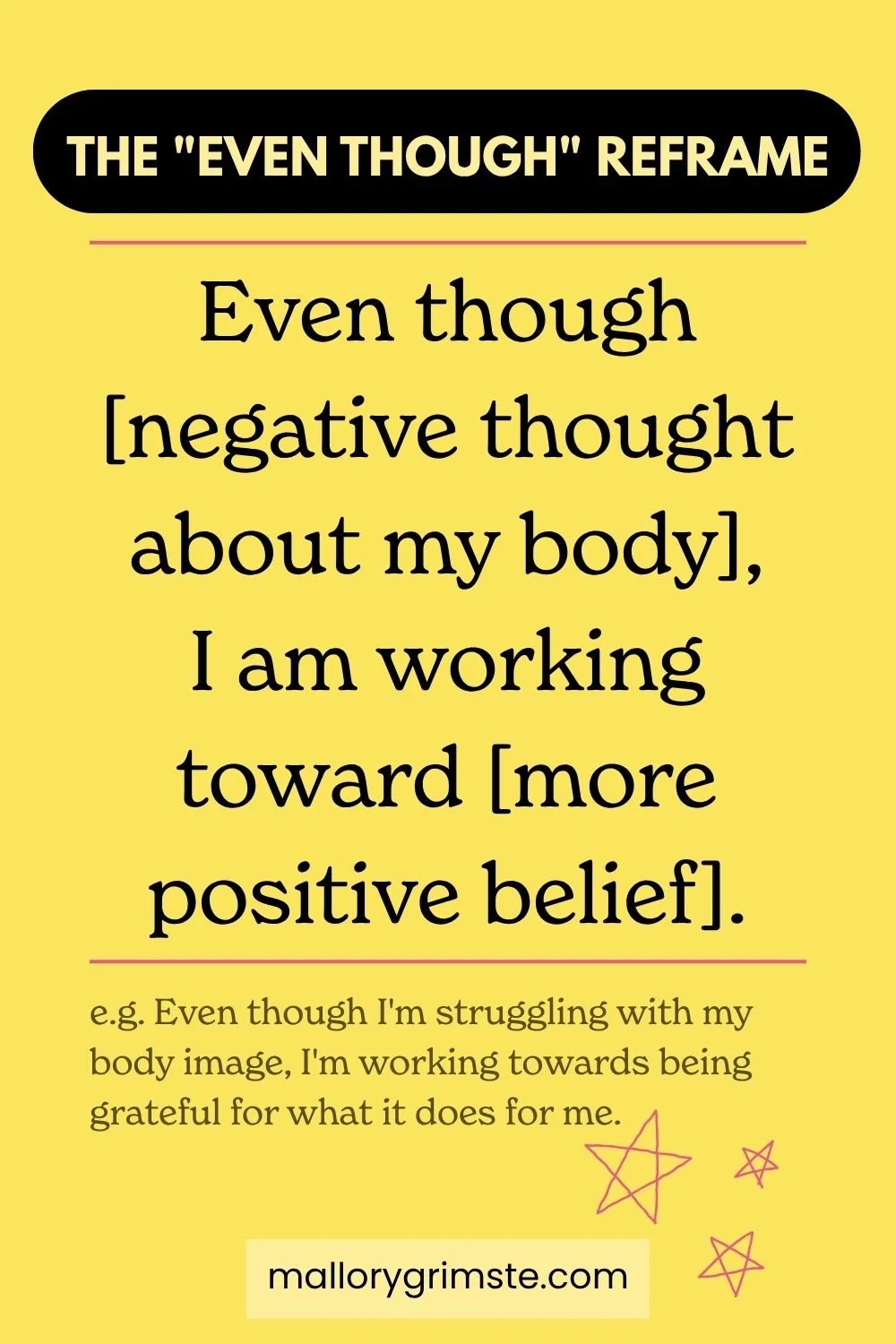
So here's the move: the "even though" reframe:
Take your negative automatic thought and put the words "even though" in front of it. Then add where you're actually headed:
"Even though [automatic negative thought about your body], I am working toward [more positive belief]."
So instead of forcing yourself to say "I love my stomach" when that genuinely feels like a lie right now — try:
“Even though I'm really critical of my stomach, I am working toward feeling more neutral about it."
That's a thought you can actually believe. And believable is way more powerful than perfect.
I'd love to hear how you're using this one: drop it in the comments on the YouTube video if you feel comfortable sharing.
3. Self-Soothe
When it comes to our bodies and our body image, our bodies give us a lot of physical feelings and responses. It tends to give us a little more information about how we feel physically and emotionally about a situation or circumstance. Sometimes it can get a little haywire and a little extra. It can really kind of shout at us. If you've ever had a panic attack, or a stress-anger spiral, you've definitely felt that physical discomfort that comes with intense emotions.
That's where coping strategy number three comes in: self-soothe.
When your body is physically distressed or uncomfortable, I want you to use one or more of your five physical senses — sight, smell, sound, taste, or touch — to physically soothe, calm, or relax what your body is experiencing in that moment.
One of the ways I really recommend: using some lotion or cream on your skin — one that feels and smells good to you. (If you have sensitive skin, obviously honor that.)
→ It could be wearing clothing that feels really good and comfortable on your body.
→ It could be drinking something that feels great. I really, really love hot cocoa.
You can use a whole bunch of different strategies to physically soothe your body's response to stress. And you can amplify all of it by combining it with coping skill number four — expressing gratitude.
4. Express Gratitude
This is really, really cool, because you can actually combine all of the first four coping skills together in this one strategy.
When you are acknowledging your body, transforming your automatic negative thoughts, and self-soothing — you can go through your different body parts and express gratitude for the work and effort that body is doing to help you live the life you are living.
Try it in the shower. As you're washing different areas of your body, express gratitude for what that body part is doing to keep you in this world.
🦶 Washing your feet? Thank you for carrying me and moving me to different places.
💪 Washing your forearms? Thank you for the arm strength to carry things, lift things, help me up.
Get creative. Expressing gratitude for what your body is already doing — right now, today — can really help transform your relationship with it.
5. Check Your Surroundings
We are constantly surrounded by different information sources and people and other bodies — if you just take a moment and look around in your actual physical environment.
❌ Not on your screens ❌ Not in your movies ❌ Not on your social media feeds ✅ But actually out in the world
...you will see there are so many beautiful people. All different shapes and sizes and colors and different aspects of their bodies. And like, gosh, everybody just has such beauty within themselves.
It's really, really easy to forget this when your social media feed is only showing you one type of body — and not being open to the fact that we are all made of different shapes and sizes.
When you check in with what you are surrounding yourself with, and make a conscious effort to fill your world with diverse body experiences, it will absolutely help transform your own relationship with your own body image.
Start small: unfollow one account that consistently makes you feel bad. Follow one that makes you feel like yourself.
Ready for More Support?
If you've been nodding along to this post and thinking okay but I need more than five tips — that's real, and it makes sense.
Body image stuff doesn't always live on the surface. Sometimes it's tangled up with anxiety, depression, how you feel about your identity, or patterns that have been there a long time. A blog post is a starting point — not the whole picture.
Your Calm Code is my DBT-informed self-help program for teens and young adults working through exactly this kind of thing — the negative self-talk, the emotional overwhelm, the feeling that your brain is working against you. It's self-paced, you can start it today, and it teaches the same skills I use with clients in session.
→ Learn more about Your Calm Code
And if you're ready for one-on-one support — I work with teens and young adults in individual therapy, in-person in Branford, CT and via telehealth anywhere in Connecticut or New York.
Either way, you don't have to figure this out alone.
💛 Mallory
